
Published
Last updated
For ADHD decision fatigue, the WebToolBase.com weighted random picker can settle a low-stakes choice between chores, meals or first tasks. List options you can do now, draw once and take the smallest next action. For the first draw, divide each option’s weight by the total weight to find its chance.
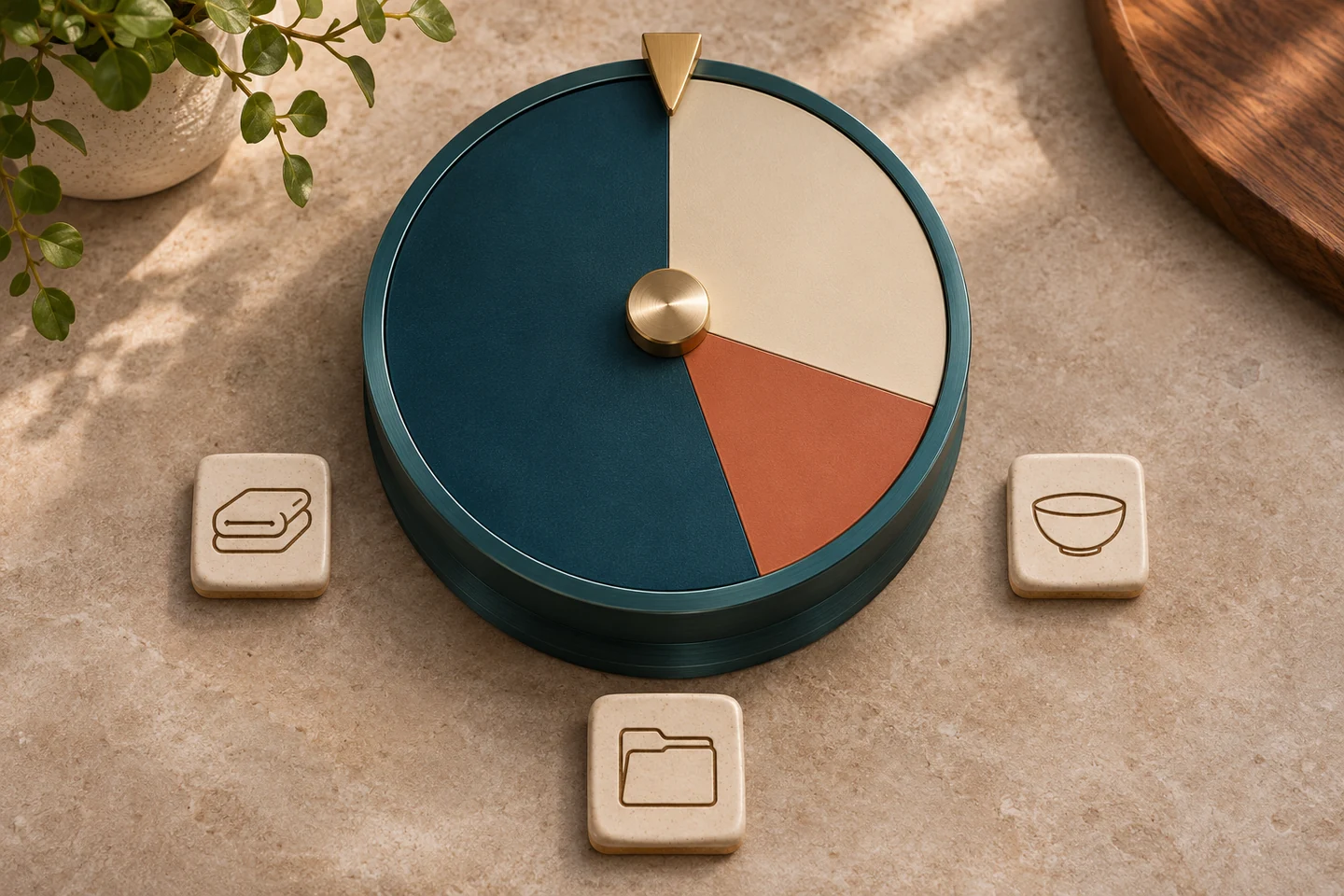
Dinner has to happen, the counter is crowded, and every small chore seems to have an argument for going first. If several choices would work, a weighted random picker can make the tie-break quick. Choose a few options you can do now, give a preferred one more weight if you like, and start with the result.
What does ADHD decision fatigue feel like?
Decision fatigue describes the feeling or drop in performance some people notice after repeated choices. Analysis paralysis describes getting stuck weighing a choice. They can feel similar at 6 p.m., but they call for different questions. How many more decisions does dinner actually require? What information, if any, would change the choice?
A list of three acceptable meals can take care of the first problem. Missing information needs a different move. If you cannot remember which leftovers are still safe or whether a guest has an allergy, check that first. Once food safety and other requirements are settled, a random draw can handle the remaining preference.
Kathleen Vohs, Roy Baumeister and colleagues reported that making choices affected performance on some subsequent tasks in a 2008 series of experiments. A 2021 preregistered study of 3,531 participants across 36 labs reported that “preregistered analyses did not find evidence for a depletion effect.” Both papers examined performance on follow-on tasks. Use the wheel to settle a tie you have decided is safe to leave to chance.
How does a weighted random picker work?
Think of each weight as a number of tickets. A three-ticket choice has three times the first-pick chance of a one-ticket choice. The same odds apply if you double every weight. The ratios are what matter. A draw can still land on the least likely option.
| Choice | Weight | First-pick chance |
|---|---|---|
| Clear the kitchen counter | 3 | 3 ÷ 6 = 50% |
| Fold five towels | 2 | 2 ÷ 6 = 33⅓% |
| Take out recycling | 1 | 1 ÷ 6 = 16⅔% |
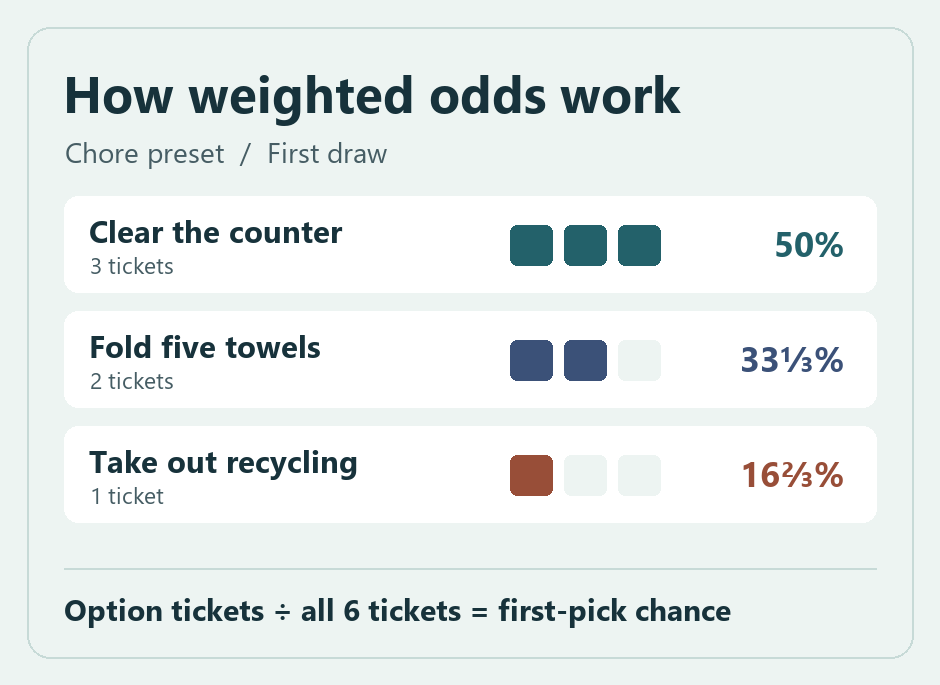
For a second pick in the same run, the wheel removes the first selected line and divides the remaining weights by their new total. If the counter comes up first, the towel choice has two of the three remaining tickets. The recycling has one. If you run the wheel again from the original list, all the original options return.
Repeated entries count as separate rows. That can be useful if you deliberately want more chances for an option, but explicit weights make the odds easier to inspect. For a single dinner choice or a first task, one row per option keeps the result clear.
What belongs on a chore, meal or first-task wheel?
Each starter list uses weights of 3, 2 and 1. Load a preset and swap in choices that suit your own time, energy and supplies. The last step in the table gives each result somewhere to go.
| Preset | Try these options | After the draw |
|---|---|---|
| Chore picker | Clear the counter, fold five towels, take out recycling. | Set a short boundary and start on the named surface or pile. |
| Meal picker | Heat leftovers, make a pantry bowl, cook a freezer meal. | Take out the main ingredient or check the reheating instructions. |
| First-task picker | Open the working document, write one rough sentence, collect one reference file. | Do the specific action and decide later whether to continue. |
Pick one chore in a crowded kitchen
A ten-minute window is too short for “clean the kitchen.” Check the space and keep actions that fit. Clear one counter section, fold five towels, or take out the bag that is already tied. Give the counter weight 3 if you want space to make lunch. If a spill needs prompt attention, handle it first and spin for the remaining tasks.
Choose dinner from what is already available
Look at the fridge before you build the menu. Remove choices that require a shop trip or a cooking time you do not have. If heating leftovers would use food you want to finish today and the other meals are also workable, give leftovers more weight. Once it comes up, put the container on the counter and make the next decision only after that move.
Find the first action on a project
“Work on invoices” still leaves several decisions open. Try “open the invoice folder,” “find one unpaid invoice,” or “draft the subject line for one follow-up.” Each one is a small physical action. If one step is a prerequisite, do it first. When you know the task but have trouble initiating it, the Task Paralysis Breaker and Executive Dysfunction Starter can help frame a smaller move.
Use the result without getting stuck in rerolls
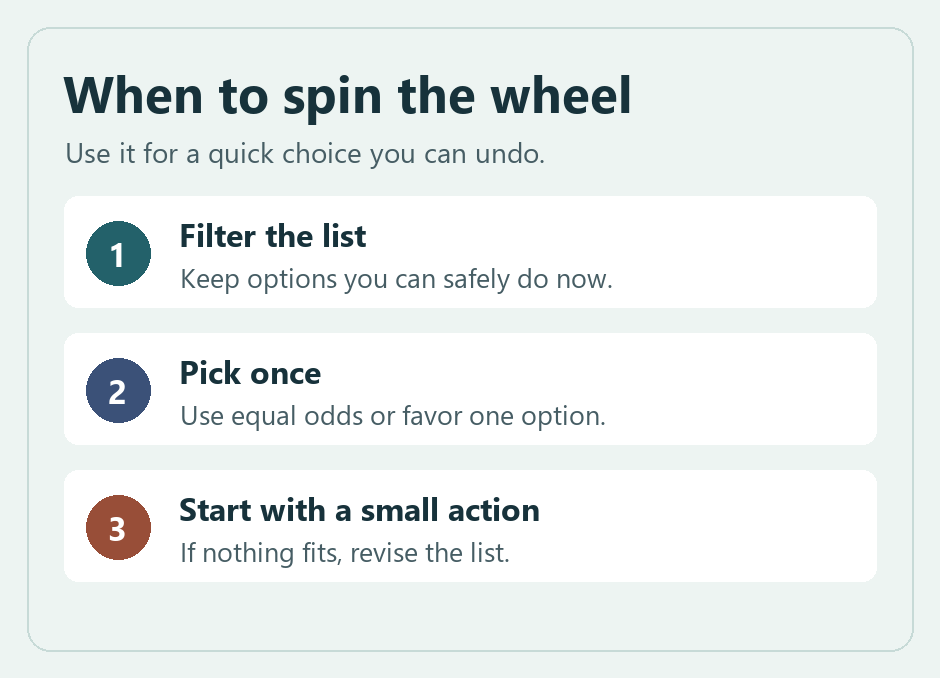
- Filter first. Keep two to five acceptable choices that fit the time and resources you have.
- Set the odds. Keep weights equal for a pure tie-break, or give a modest preference an extra ticket.
- Pick once. If the option works, start with the smallest visible action. If it cannot work, fix the list before picking again.
Your reaction to the result may tell you something. If “make a pantry bowl” comes up and you immediately realize you wanted leftovers, make the leftovers. If you are tempted to redraw every time, choose a default ahead of time or ask what constraint the list missed. Repeated spins can bring back the same deliberation you meant to finish.
When is a list or timer a better fit?
| If the sticking point is… | Try this | Why it fits |
|---|---|---|
| Several options would be fine | Random Picker | Settles a tie with equal or weighted odds. |
| A known deadline or requirement | A written priority or deadline | Puts the requirement first, before any draw. |
| A task is too big to start | Task Paralysis Breaker | Makes the next action smaller and more concrete. |
| A full day of too many tasks | 3-3-3 Method Planner | Checks what fits in the time available. |
| You picked a task and want a stop time | Body Doubling Focus Timer | Gives the first session a clear end. |
A standing default can save more effort than a wheel for a repetitive choice. You might keep a ready-to-heat meal for late evenings and reserve the random picker for days when several options fit. To collect a short list before you need it, use the Dopamine Menu Generator for breaks or keep a plain-text file for chores and meals.
Questions about weighted picking and ADHD decision fatigue
How do I use a random picker for ADHD decision fatigue?
Write two to five safe, doable options, draw once and start the smallest action in the result. Use a preset when the list itself is taking longer than the choice.
Can I spin a chore wheel without creating an account?
Yes. The WebToolBase Random Picker runs in your browser and requires no account. Load the Chores preset or type your own list, one choice per line.
What does a weight of 3 mean on a random picker?
It gives the option three times the first-pick chance of an option with weight 1. If the total weight is 6, the option weighted 3 has a 50% first-pick chance.
Should I use the picker for an important decision?
Use a wheel for choices you can safely reverse. For consequential decisions, gather the missing facts, compare relevant criteria and seek appropriate advice when needed.
Does a random picker treat ADHD or cure decision fatigue?
A wheel is a practical tie-breaker for small decisions. Research has yet to establish that it treats ADHD or cures decision fatigue.
Try it with one decision today
Pick a small choice you are still carrying around. If three options are workable, put them in the weighted Random Picker, draw once and take the first action. For a choice that keeps coming back, keep the list somewhere easy to reach.
Last verified November 17, 2026.