
Published
Last updated

The grocery trip looks like one line on the list. Getting dressed, reaching the shop, making decisions in a noisy aisle, carrying bags home and putting food away tell a fuller story. A calendar can show enough time for all of it while leaving out the effort that makes the trip possible.
Spoon theory uses a limited collection of spoons as a metaphor for personal capacity. An energy budget applies that idea to the activities you are considering: choose your own available estimate, keep some capacity unassigned and compare the whole cost of the plan. No spoon count can measure your health or tell you what your body should be able to do.
Open the free spoon theory calculator and personal energy budgeter beside this guide. The worked example starts with 12 spoons, reserves 2 and assigns 10 to six activities. You can replace every estimate, remove tasks and download the plan without creating an account.
Where spoon theory comes from
Writer Christine Miserandino introduced the metaphor in her 2003 essay The Spoon Theory, describing an attempt to explain life with lupus to a friend. Handing over a finite set of spoons made everyday choices tangible. Her account concerns the experience of illness and the effort hidden inside ordinary activities, rather than a method for squeezing more work into a day.
Read Miserandino’s original essay, reproduced as a PDF for that personal context. The calculator and examples here are WebToolBase’s independent planning adaptation. They are not a clinical scale, a reproduction of her task costs or an endorsement by the author.
What a personal energy budget can tell you
A useful budget makes a choice visible before the day becomes overfull. If an appointment and its travel already occupy much of your estimated capacity, the remaining choices need to reflect that. A short list with honest costs can be more informative than a long list whose items all look equally easy.
Treat the numbers as a working language. “Two spoons” might mean noticeably demanding to you. It does not establish the same experience for a partner, colleague or another person with the same diagnosis. Even your own estimate may change when the setting, support or symptoms change.
The arithmetic is deliberately modest: available estimate – reserve – activity estimates = unassigned room beyond reserve. A negative result exposes a mismatch in the numbers you entered. A positive result does not certify that a plan is safe, comfortable or achievable. Your experience takes priority over the display.
Choose an estimate that belongs to today
Begin with the day in front of you, rather than the day you wish you had. Consider what is already required and what you have noticed about your current capacity. You do not need to justify the number to earn permission to make a smaller plan. If assigning numbers itself becomes tiring, a few words such as low, moderate or uncertain may be enough on paper.
Twelve is convenient for illustrating the calculation, not a standard allowance. Starting with six, eight or twenty does not make a person better or worse at managing their life. Keep your scale reasonably consistent when comparing your own notes, and avoid using it to compare people.
Distinguish a lower starting estimate from a higher activity cost. You might describe a generally difficult day with fewer available spoons. A particular trip with an extra connection might instead deserve a larger travel estimate. Both can be appropriate, but ask whether you have counted the same change twice. The aim is a usable choice, not mathematically precise physiology.
Estimate the whole activity, including its edges
“Laundry” could mean placing one prepared load in a nearby machine, or sorting clothes, carrying a basket downstairs, waiting, returning and folding everything. Those are different activities. Write the version you actually intend to do and give it a stopping point.
For each candidate task, consider preparation, the activity itself, changes of setting and what must happen afterwards. A telephone appointment may involve finding paperwork and making notes after the call. A meal can include choosing food, cooking and clearing the preparation area. Account for those parts once, either inside the task estimate or on separate lines.
Physical effort is only one consideration. Concentration, conversation, sensory conditions and uncertainty may matter to your own planning. A half-hour video meeting and half an hour spent quietly sorting familiar papers can feel very different. This is a reason to personalize the estimate, not evidence that one activity has a scientifically established spoon price.
A worked 12-spoon day with common chores
The table below is an invented planning example for one person. Its numbers are not recommended costs for these chores. Replace them with your own descriptions and estimates, especially if an activity is inaccessible, unnecessary or much more demanding in your circumstances.
| Activity in this example | Personal estimate | What the estimate includes |
|---|---|---|
| Wash and dress | 1 spoon | The chosen morning routine, with clothes already selected |
| Prepare breakfast | 1 spoon | A familiar simple breakfast and putting ingredients away |
| Small laundry load | 2 spoons | One defined load, rather than all household laundry |
| Grocery trip | 3 spoons | Travel, shopping, carrying bags and putting food away |
| Important message | 1 spoon | Reading the request and sending one bounded reply |
| Simple dinner | 2 spoons | The selected meal and its basic preparation cleanup |
| Total activities | 10 spoons | 1 + 1 + 2 + 3 + 1 + 2 |
| Reserve | 2 spoons | Left unassigned within the 12-spoon starting estimate |
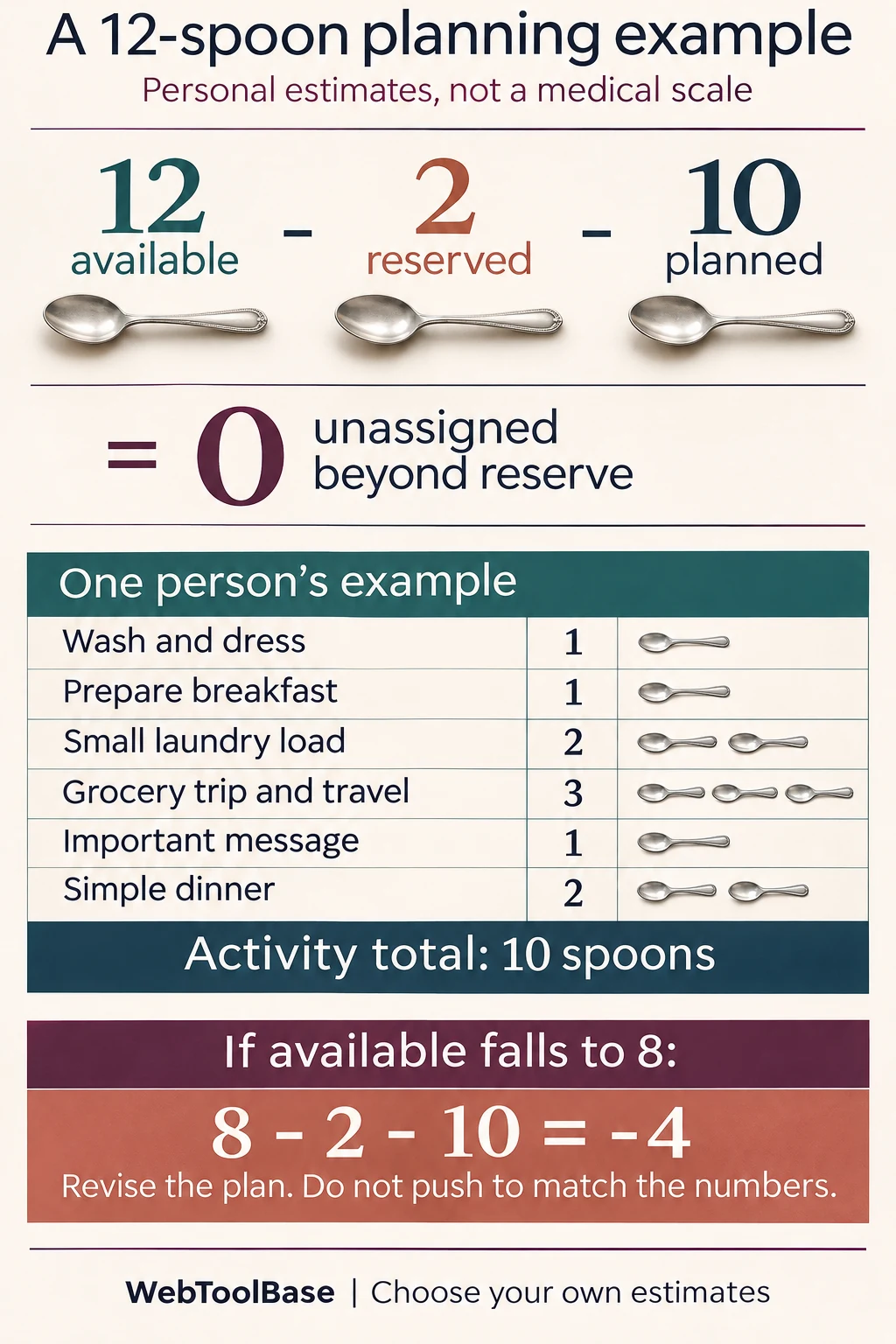
With 12 available, 2 reserved and 10 assigned to activities, the result is zero unassigned beyond reserve. The reserve has not disappeared. It remains deliberately outside the planned activities. Nor does a tidy total turn six tasks into an obligation to finish them all.
Notice what this example leaves out. It is not a complete day for someone with paid work, caregiving, appointments or additional personal-care needs. Add the real demands of your day before relying on the calculation. When those demands already exceed the estimate, the next step may involve help or changing commitments, rather than finding a cleverer task order.
When capacity changes, change the plan
Suppose the available estimate falls from 12 to 8 while the reserve stays at 2. The unchanged activities still total 10. Now 8 – 2 – 10 = -4, so the plan exceeds the entered budget by four spoons. Changing the color of a checkbox cannot resolve that mismatch.
One possible revision is to defer the small laundry load, removing two spoons. Another is to replace the grocery trip with help and estimate the remaining ordering or coordination effort at one spoon instead of three. Together those changes reduce the activity total to six. The revised calculation is 8 – 2 – 6 = 0.
That solution only works if the help is actually available and the revised estimate fits the person. Delivery may cost money; asking someone to shop can itself require coordination. If either change is unrealistic, use a different option. An example should make tradeoffs visible rather than pretend that everyone has the same resources.
Four ways to revise an overfull energy budget
| Choice | A concrete revision | What to check |
|---|---|---|
| Reduce scope | Wash the items needed tomorrow rather than every load | Does the smaller version meet the immediate need? |
| Defer | Move a nonurgent form to a less demanding day | Will waiting create a deadline or other consequence? |
| Change the method | Use a simpler meal with fewer preparation steps | Does the alternative suit your access, cost and dietary needs? |
| Ask for help or renegotiate | Request grocery help or a different meeting arrangement | Who can help, what is being asked and when is an answer needed? |
Some demands cannot simply be postponed. Food, necessary care and responsibilities to dependants deserve explicit space before optional tidying or extra project work. If essential needs cannot be met within your current circumstances, the issue may be access to support. A calculator cannot solve a lack of care, money, transport or workplace flexibility.
Keep a small reserve because estimates have uncertainty. The right amount is your choice, and a reserve is not a protective guarantee. Avoid quietly assigning it to another task the moment the total looks comfortable. If a new demand arrives, decide openly what changes rather than carrying the whole original plan forward unchanged.
Rest belongs in the day, without a promised refill
You can make room for rest without entering it as a negative-cost task. The WebToolBase budgeter does not automatically return spoons after a break, a nap or a pleasant activity. It cannot know how you will feel afterwards, and a fixed refill would create precision the metaphor does not support.
A calm activity may still require something from you. Social time can be valuable and demanding at once. Write down what you want the activity to provide, then decide what space it needs. “I want a quiet conversation with a friend” is a clearer choice than labeling every enjoyable activity as free capacity.
For a menu of optional break ideas, the practical dopamine-menu guide offers a separate planning approach. Choose an option that fits your circumstances. Neither that menu nor a spoon counter can promise a particular change in energy or attention.
Spoon theory, pacing and health limits
An energy metaphor and a medical management plan serve different purposes. For ME/CFS, the CDC explains activity management, also called pacing, around individual limits for physical and mental activity. It notes that post-exertional symptoms can worsen 12 to 48 hours after activity and last much longer. Feeling able to continue immediately does not establish that exertion is safe.
A generic spoon total cannot predict those delayed effects or replace condition-specific advice. If you have ME/CFS or another condition affecting exertion, follow the plan agreed with an appropriate healthcare professional. Seek clinical advice for new, persistent or worsening fatigue or other symptoms. Do not increase activity simply because this calculator leaves a positive number.
Using the idea with ADHD or AuDHD
If you have ADHD or identify as autistic and ADHD, you may find it useful to name demands that a calendar misses. Setting up an unfamiliar task, changing environments or handling several conversations can belong in your personal notes if those factors matter to you. There is no universal ADHD or AuDHD spoon budget.
A smaller next action can clarify what you are estimating. “Open the application and list the missing documents” has a different scope from “complete the application.” The Task Paralysis Breaker can help you formulate a starting action. It does not determine whether you have capacity to carry it out.
Avoid turning the budget into a daily performance test. This tool is not an ADHD treatment, an autism assessment or a burnout-prevention system. Keep the parts that help you describe a choice and discard the parts that make planning another demanding obligation.
Check both the clock and the effort
Time and capacity are separate constraints. You might have two free hours without wanting to spend them on a demanding errand. Conversely, a task that feels manageable can still make you late if you omit travel and preparation. A useful plan needs to make sense on both dimensions.
For a departure deadline, the Time Blindness and Buffer Calculator works with time estimates and a buffer. For organizing project work alongside shorter obligations, the 3-3-3 productivity guide and its daily planner check a different question. Do not convert one spoon into a fixed number of minutes merely to make the tools agree.
Use a short review to improve your own estimates
After the activity or at a suitable later point, record whether the estimate was close, low or high and what affected it. “The store was crowded and I had to wait for transport” is more useful than “I failed at shopping.” A few specific notes can explain why the same task needs a different plan next time.
Where delayed effects are relevant to your health, use the monitoring approach recommended for your care rather than relying on an immediate end-of-task score. Keep health records separate from a shared planning screen when that is more appropriate. The budgeter is for comparing entered estimates, not analyzing symptoms.
You do not need an elaborate tracking system. A brief note about the activity, circumstances and a possible adjustment may be sufficient. If keeping records becomes burdensome, reduce the detail. The purpose is to support a future decision, not to produce a perfect archive.
How to explain a change of plans to someone else
A number is optional when communicating a boundary. Describe what is possible and the decision you need: “I can join the call, but I cannot also make the trip today. Could we handle the paperwork online?” That gives the other person a practical way to respond without requiring them to accept your private scoring system.
Specific requests are easier to act on than a general wish for less pressure. You might ask for the shopping to be collected, a written agenda before a meeting or permission to divide a household task across days. These are examples to consider, not guarantees of access or formal accommodation advice.
Save a plan you can actually return to
The browser budgeter keeps entries only while the page session remains open. Refreshing clears them. There is no automatic saving or device sync, so download the checked text plan or print a copy before leaving. Recheck after editing: the previous result hides when an input changes.
For a notebook-style option, the WebToolBase digital planner collection includes Mind & wellbeing pages for capturing thoughts and reflection. That is a separate paid format, not a medical program or a requirement for using the free calculator. Choose a place you can comfortably revisit when the day changes.
Questions about spoon-theory energy budgeting
How many spoons should I start with?
There is no prescribed daily number. Twelve is the example used in this guide and calculator, not a threshold for health, disability or productivity. Choose a scale that helps you describe your own choices, or use words instead if numbers do not help.
How many spoons does a shower or an email take?
No universal table can answer that. The particular activity, environment, support and your circumstances all matter to the estimate. Define the version you mean, include preparation and follow-up, and revise your own estimate when you learn something useful.
Does zero remaining mean I used all my spoons?
In this calculator, zero means nothing remains beyond the reserve after subtracting planned activity costs. With 12 available, 2 reserved and 10 planned, the reserve is still unassigned. The result is a statement about entered numbers, not your physical condition.
Can I borrow spoons from tomorrow?
The calculator does not treat future capacity as a loan you can safely spend. Tomorrow’s circumstances are unknown. If today’s plan exceeds the entered budget, revise the commitments or seek support rather than entering an assumed repayment scheme.
Is spoon theory a proven treatment?
This guide uses it as a metaphor and communication aid. It does not establish treatment effectiveness, and the calculator has not been clinically validated. Condition-specific pacing and other health decisions require advice appropriate to the individual.
Start with one real decision, such as whether today can include both the errand and the laundry. Put the full versions into the personal energy budgeter, examine the tradeoff and change the plan when needed. The useful result is a choice that reflects your circumstances.