
Published
Last updated
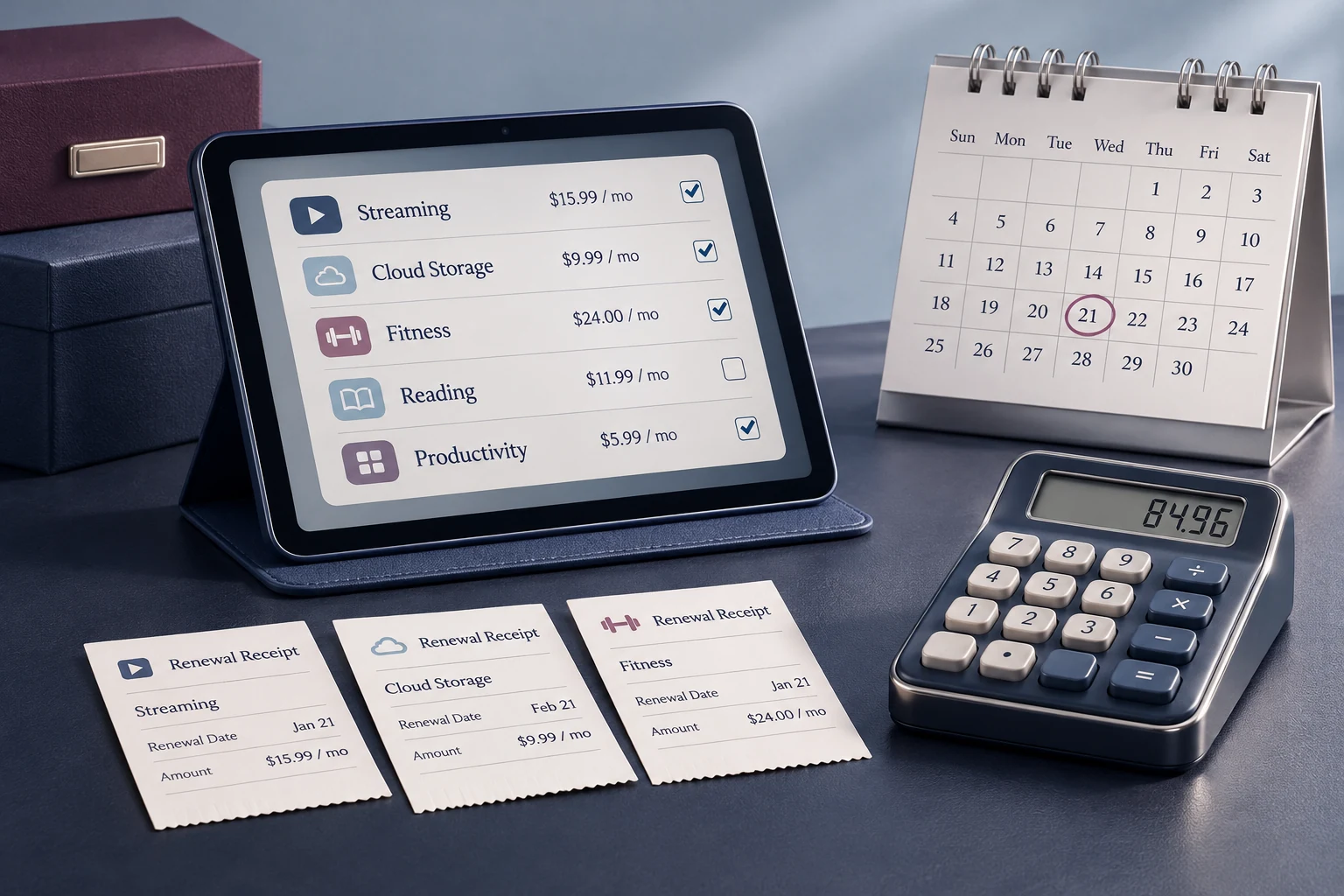
To calculate your “ADHD tax,” list avoidable recurring costs, convert every bill to a monthly equivalent, and add average late fees and avoidable impulse spending. Multiply by 12 for annual cost. Keep past one-time losses separate. Then cancel what you no longer need, keep confirmation and check the next statement. The free subscription audit calculator handles the arithmetic and provides an audit CSV and personal report.
A trial you meant to cancel can feel too small to investigate. Several forgotten renewals can make the bank balance harder to explain. This audit gives each charge a decision and a next action, without turning a missed reminder into a judgment about your character. You can begin with one statement and finish the rest in short sessions.
Reviewed November 23, 2026. The examples below are original illustrations in US dollars. Use one currency throughout your own audit. This worksheet is educational; it does not diagnose ADHD, cancel a service or promise savings.
What “ADHD tax” means in a spending audit
People use the informal phrase “ADHD tax” for extra costs associated with forgetting, putting off administration or acting on an impulse. It is not a government tax, a clinical measurement or a cost that everyone with ADHD experiences. A subscription audit can help anyone who has lost track of recurring charges, whether or not they have an ADHD diagnosis.
Focus on the cost you can change. A useful service is not waste simply because it renews automatically. Paying for grocery delivery, reminders or software may be a deliberate choice that supports your day. Mark a cost avoidable only when you would prefer to stop or reduce it and can do so without losing something more valuable.
The subscription statistic, with its date and limits
In C+R Research’s 2022 survey of 1,000 self-reporting US consumers, the average initial estimate was $86 per month. Itemizing subscriptions produced an average of $219, a $133 gap and about 2.55 times the initial estimate. The survey ran from April 22 to May 2, 2022. It was not an ADHD-specific study or a measurement of 2026 spending.
Those figures describe a survey average, not the amount you personally waste. Some subscriptions in the total may have been wanted and used. Your statement, current renewal price and actual share of each bill provide a better basis for a cancellation decision than applying someone else’s average to your budget.
Start with evidence you already have
Open a bank or card statement for a recent complete month. Search for repeated merchant names, small app charges, memberships and free-trial conversions. Check a longer history for annual renewals, since one month can miss them. Email searches for “renewal,” “subscription,” “trial,” “receipt” and “invoice” can uncover billing accounts that are easy to overlook.
App-store subscriptions deserve their own check. Compare the billed amount with your Apple or Google Play subscriptions and with any direct account on the provider’s website. A merchant name on a statement may differ from the app’s name. Match dates and receipts before treating two similar amounts as a duplicate or disputing an unfamiliar charge.
Keep a private record of the service name, amount per bill, billing cycle, next renewal, account owner and decision. Do not place card numbers, bank credentials or passwords in the calculator, a CSV or a shared planner. For family subscriptions, record the portion you actually pay and check with the other users before cancelling.
Convert monthly, annual, quarterly and weekly bills correctly
Different billing cycles can make inexpensive-looking plans difficult to compare. Put them on a monthly basis first, using the price you expect at renewal. The introductory trial price may not be the ongoing price. Include known tax in the amount you actually pay, and avoid adding it a second time later.
| Billing cycle | Monthly calculation | Original example |
|---|---|---|
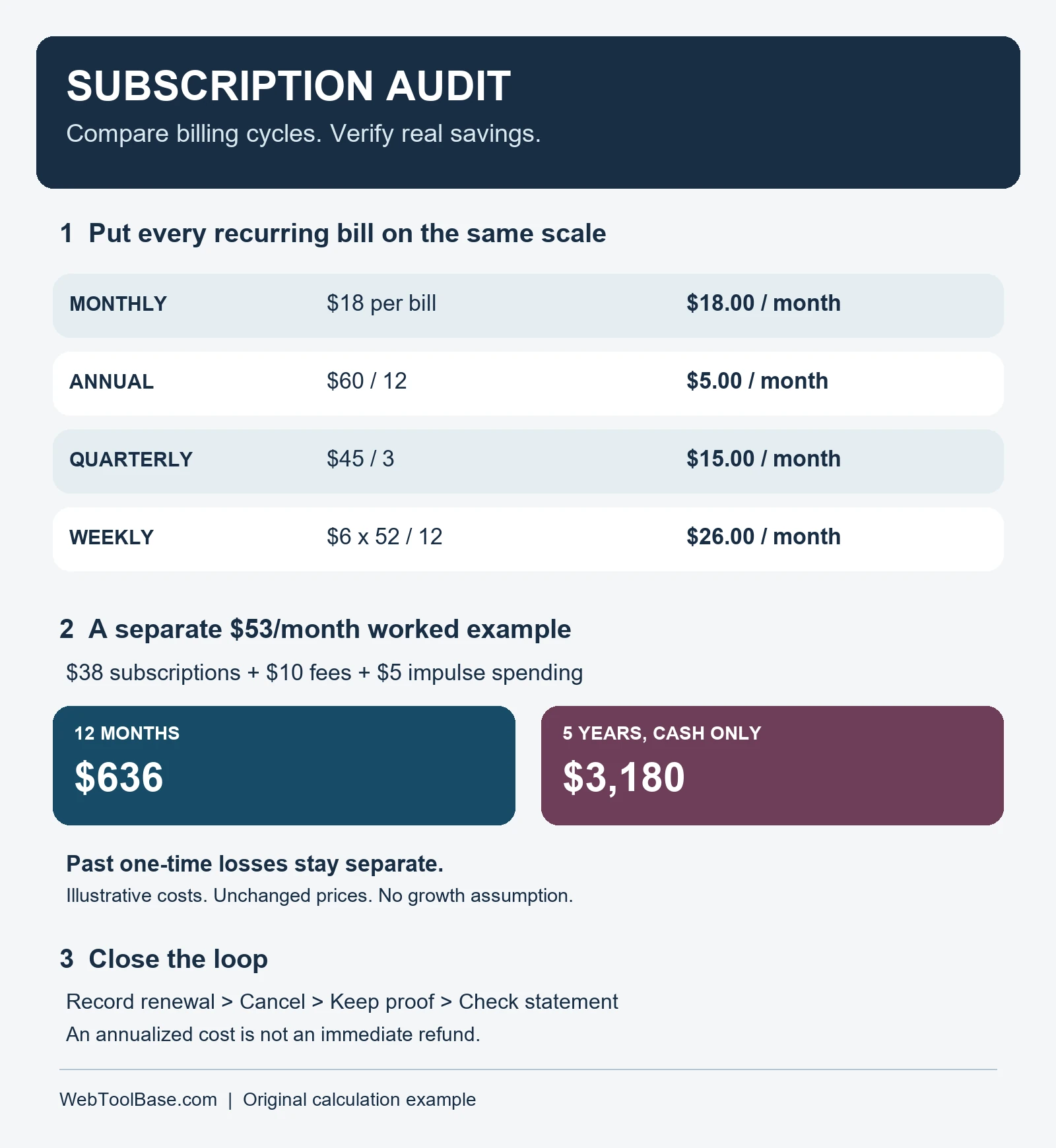
| Monthly | Amount per bill | $18 becomes $18/month |
| Annual | Amount / 12 | $60 becomes $5/month |
| Quarterly | Amount / 3 | $45 becomes $15/month |
| Weekly | Amount x 52 / 12 | $6 becomes $26/month |
| Past one-time loss | Record separately | $80 remains a past $80 cost |
Weekly billing is especially easy to undercount. Multiplying $6 by four gives $24, while the 52-week convention gives $26 per month on average. An average month is not exactly four weeks. The calculator uses 52 weeks per year for comparison; your actual statement dates determine the cash that leaves in a particular month.
Annualized cost and available cash are different. Ending a $60 annual subscription might prevent the next $60 renewal without producing a $60 refund today. Dividing by 12 helps you compare options. It does not change the contract, refund terms or date when a payment would have occurred.
Build a clean total without counting a loss twice
Add the monthly equivalents of subscriptions you have selected as avoidable. Then add representative monthly late fees and the portion of impulse spending you intend to reduce. If late fees totaled $30 across three representative months, use $10 per month. A single unusually expensive month may not describe what will happen next.
Use mutually exclusive categories. If a forgotten renewal is already in the subscription list, do not include it again as impulse spending. Keep a missed refund, replacement purchase or expired credit in the one-time field. You can learn from a past loss without multiplying it by another 60 months.
Monthly recurring cost = normalized subscriptions + average monthly late fees + avoidable monthly impulse spending. Annual cash cost equals that monthly total x 12. Five-year cash cost equals the same total x 60. Both projections assume the entered costs and prices continue unchanged, so treat them as scenarios you can revise.
Worked example: $53 per month, with and without growth
Imagine you decide to stop an $18 monthly streaming service, a $60 annual app and a $15 monthly membership. The subscription subtotal is $38 per month. Add $10 in average monthly late fees and $5 in avoidable impulse spending. The resulting $53 monthly total would cost $636 over one year or $3,180 over five years if it continued.
| Scenario | Five-year cash contributed | Hypothetical growth | Five-year total |
|---|---|---|---|
| Cash only, 0% | $3,180.00 | $0.00 | $3,180.00 |
| Illustrative 5% effective annual rate | $3,180.00 | $414.13 | $3,594.13 |
The 5% line assumes $53 is actually set aside at the end of each month for 60 months. Its monthly rate is (1 + 0.05)^(1/12) minus 1. It excludes tax, fees and inflation and is not a predicted return. Cancelling a subscription does not automatically create an investment balance. The cash-only line is the clearer starting point for planning.
A cancellation is also not the same as verified savings. Suppose you stop a service but buy an equally priced replacement. The renewal is gone, yet your household spending has not fallen by the full amount. Keep a separate actual-savings total based on statements, refunds received and replacement costs.
Nine common audit questions and the next useful action
| Question | What to check | Next action |
|---|---|---|
| Where are forgotten trials? | Statements, receipts and app-store accounts | Identify who bills you and the renewal date |
| How do I compare annual prices? | Full renewal amount, including known tax | Divide by 12 for comparison |
| Why is a weekly plan expensive? | Number of billing weeks | Use amount x 52 / 12 |
| What belongs in late fees? | A representative period of avoidable fees | Divide by months in that period |
| Should all impulse purchases count? | Only the amount you intend to change | Exclude renewals already counted |
| What about a past one-time loss? | Whether it is already incurred | Keep it out of recurring projections |
| Who can cancel a shared plan? | Account owner, users and your share | Agree on the change first |
| Did cancellation actually work? | Confirmation and next statement | Record the final charge check |
| What should I review next month? | Actual renewals, refunds and replacement costs | Update the audit with observed results |
Cancel through the company that actually bills you
Read the current cancellation and refund terms before taking action. Apple’s cancellation guide explains how to find the relevant subscription and billing account. Google Play’s guide warns that uninstalling an app does not cancel its subscription. If the provider bills you directly, use that provider’s own account or support process.
Write down the date you requested cancellation, its effective date and the confirmation reference. Check whether access ends immediately or at the end of a paid period. Save the confirmation privately and schedule a statement check after the next expected billing date. If you requested a refund, record it as pending until it is confirmed.
Payment controls need separate attention. The CFPB’s automatic-payment guidance explains that stopping a debit does not cancel the underlying contract or debt. Contact the company and your bank when appropriate, keep records and promptly report an unauthorized transfer. Follow your bank’s process rather than assuming a replaced card or blocked debit ends an agreement.
Make the next renewal easier to handle
Choose a reminder date that leaves enough time to review the service and complete its cancellation process. Put the real renewal amount and a direct account link in the reminder. “Review $60 app before renewal” is easier to act on than a vague task called “finances.” Avoid storing a password in the event description.
A short weekly administration slot can catch a trial before it becomes another annual charge. The 3-3-3 method planner can reserve a maintenance block, while the body-doubling approach offers a way to work alongside someone during an unpleasant task. Use whichever structure reduces the work required to begin.
Autopay can still be useful when the service is wanted and the balance can support the payment. The CFPB describes both convenience and overdraft risks. Pair any automatic payment with a balance check and a reminder you can realistically notice. Choose a system based on your cash timing rather than treating every automatic payment as a mistake.
Get the free audit CSV and your personal report
Open the ADHD tax and subscription audit calculator, enter one line per service, and choose “Download audit CSV template.” The template includes the amount, billing cycle, monthly equivalent, renewal date, decision, cancellation deadline, confirmation reference and final-charge check. Delete the labeled example rows before entering your own services. The CSV gives you a portable record you can use without buying a planner.
After calculating, download the HTML report for a snapshot of your entries, assumptions and next actions. It includes a linked WebToolBase.com footer and can be opened in a browser. Keep it somewhere private if you include personal service names. The calculator does not preserve your entries for your next visit, so save the report before leaving if you need a record.
For a manual planning system, review the WebToolBase digital planner and its finance pages. The Android planner setup guide explains the note-taking workflow. A paid planner is optional; the free calculator, template and a calendar reminder are enough to run this audit.
A 30-day follow-up that measures what changed
Reopen the audit after the next statement arrives. Compare each cancellation with the expected billing date, record any final charge and confirm whether a refund appeared. Adjust for a replacement subscription, a price change or an annual service that was already paid. Keep projected avoided costs separate from money actually retained.
Pick one recurring review date rather than rebuilding your system every time a bill surprises you. If the audit is unfinished, the next step might be one receipt or one account, not an entire financial cleanup. The small-step task guide can help you define that first action. A useful audit ends with a checked statement and a clearer next renewal.
Frequently asked questions
Is ADHD tax an actual tax?
No. It is an informal expression for certain extra costs people associate with forgetting, delayed administration or impulsive decisions. This audit records spending you identify; it does not measure ADHD or establish why a charge occurred.
How much does a forgotten $10 monthly subscription cost?
At an unchanged $10 per month, it costs $120 over 12 months or $600 over five years. Those are cash-only scenarios. They do not include price changes, refunds, replacement services or investment growth.
Will cancelling an annual subscription refund the unused months?
It depends on the provider’s terms and applicable rules. Cancelling may only prevent the next renewal. Treat a refund as pending until confirmed, and distinguish monthly-equivalent cost from cash returned to your account.
Can I use the calculator without an ADHD diagnosis?
Yes. Anyone can use it to normalize billing cycles and review avoidable recurring costs. It requires no diagnosis or bank connection. Enter amounts manually and leave out credentials or account numbers.
What is the most useful first step if I feel overwhelmed?
Choose one recent statement and identify one recurring charge. Record its amount and next renewal, then decide whether to keep, cancel or review it. Complete and verify that action before expanding the audit.