
Published
Last updated
To estimate a bedtime, subtract 90 minutes per planned cycle and your time to fall asleep from your wake time. With a 7 a.m. alarm and a 15-minute allowance, five estimated cycles put bedtime at 11:15 p.m. The WebToolBase.com sleep cycle calculator does this arithmetic. Actual sleep stages and morning alertness can vary.

Your alarm is set for seven. A bedtime chart says 11:15 p.m., but you rarely fall asleep before one. Which number should you trust? Start with the one you can verify: how much time you actually spend asleep. The chart can help you lay out the evening. The pattern in your own nights tells you whether the schedule is workable.
What does the 90-minute sleep cycle rule calculate?
A sleep cycle calculator converts an assumed interval into a clock time. A sleep cycle itself is a sequence of non-REM and REM sleep. The National Heart, Lung, and Blood Institute describes cycles of about 80 to 100 minutes, usually four to six a night. The mix changes as the night goes on. Deep non-REM sleep tends to be more prominent earlier, with more REM later. Treat 90 minutes as a convenient input. An alarm cannot tell where you are in that sequence. NHLBI sleep stages
When wake time is fixed: bedtime = wake time minus (cycle interval × number of cycles) minus time to fall asleep.
When bedtime is fixed: wake time = bedtime plus time to fall asleep plus (cycle interval × number of cycles).
“Bedtime” here means when you get into bed and try to sleep. Fifteen minutes is the default allowance in the calculator. The tool also accepts zero and whole-minute values up to 60. Use a rough estimate from several ordinary nights if you have one. You can use either mode for free without a calculator account.
What time should I go to bed to wake up at 7 a.m.?
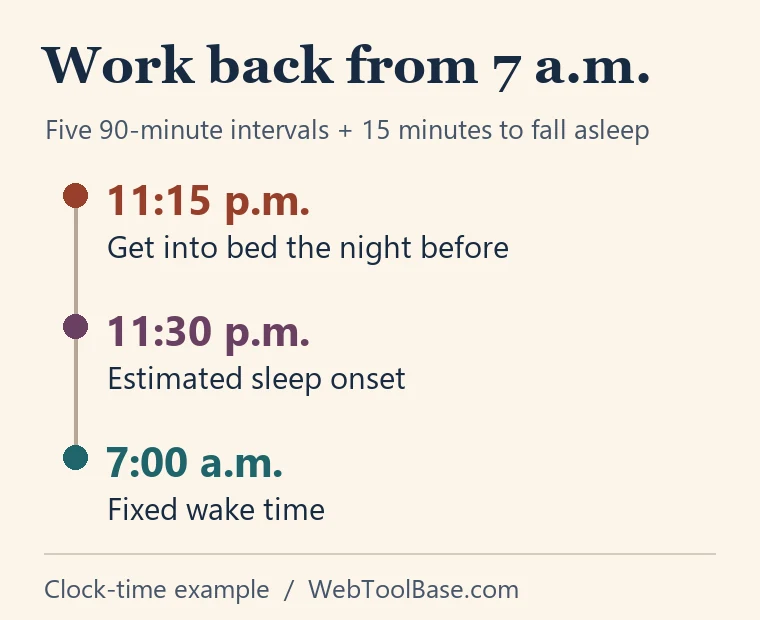
Work backward by 450 minutes for five 90-minute intervals. At 7:00 a.m., that puts estimated sleep onset at 11:30 p.m. Subtract another 15 minutes and you get 11:15 p.m. the previous night. Six intervals put bedtime at 9:45 p.m. The extra 90 minutes is a larger sleep opportunity if you can realistically use it.
| Cycles | Modeled sleep | Bedtime for 7 a.m. | Wake time from 11:15 p.m. |
|---|---|---|---|
| 2 | 3 h | 3:45 a.m. | 2:30 a.m. next day |
| 3 | 4 h 30 min | 2:15 a.m. | 4:00 a.m. next day |
| 4 | 6 h | 12:45 a.m. | 5:30 a.m. next day |
| 5 | 7 h 30 min | 11:15 p.m. previous night | 7:00 a.m. next day |
| 6 | 9 h | 9:45 p.m. previous night | 8:30 a.m. next day |
A late meeting makes the difference concrete. Suppose you get into bed at 12:05 a.m., fall asleep around 12:25 a.m. and need to be up at 7:00 a.m. Even with no overnight waking, the estimate is 6 hours 35 minutes. Moving the alarm to 6:25 a.m. would reduce it to six hours. For adults ages 18 through 60, CDC recommends at least seven hours a day. Start by asking whether any part of the schedule can move enough to protect sleep. CDC sleep duration guidance
How far off can a 90-minute estimate be?
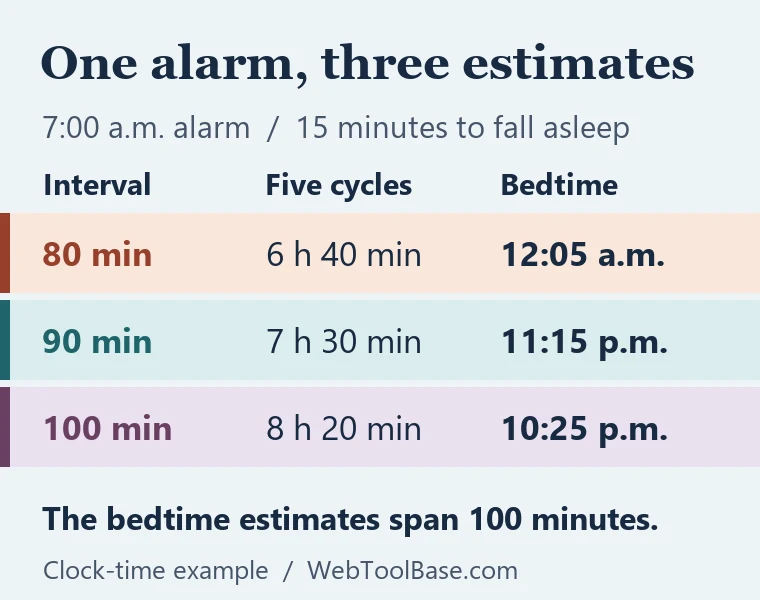
Change the assumed interval by ten minutes and a five-cycle estimate moves by fifty minutes. Holding the alarm at 7:00 a.m. and keeping a 15-minute allowance, 80 minutes yields 12:05 a.m., 90 minutes yields 11:15 p.m., and 100 minutes yields 10:25 p.m. That is a 100-minute spread from one modeling choice. Each row assumes the same interval throughout the night for easy comparison.
Time to fall asleep works differently. With the interval still at 90 minutes, using 30 minutes instead of 15 moves the five-cycle bedtime from 11:15 p.m. to 11:00 p.m. Night wakings reduce actual sleep further. If you spend 7 hours 45 minutes in bed, take 30 minutes to fall asleep and spend 20 minutes awake overnight, you slept about 6 hours 55 minutes. Estimating time in bed and time asleep separately can explain why a schedule that looked ample on paper felt short.
What changes when you have ADHD or a late body clock?
A circadian rhythm helps determine when the body is primed for sleep and alertness. A consistently late sleep window can make an early bedtime hard to use. In a study by Maaike Van Veen and colleagues, adults who had both ADHD and chronic trouble falling asleep showed later sleep timing and later dim-light melatonin onset than the ADHD group without that sleep complaint. The study compared defined groups, so its result cannot supply a diagnosis rate for everyone with ADHD. Van Veen and colleagues, Biological Psychiatry
One clue is what happens when the calendar loosens. Someone who sleeps comfortably from 1:30 a.m. to 9:30 a.m. on free days but struggles with a 7:00 a.m. work alarm may have a schedule mismatch worth discussing. A late preference by itself is common. A repeated inability to sleep and wake at required times, with effects on daily functioning, warrants a closer look. Sleep specialists can assess delayed sleep-wake phase disorder and distinguish it from other sleep problems. American Academy of Sleep Medicine circadian rhythm guideline
Before a visit, keep a simple sleep diary across workdays and free days. Write down when you tried to sleep, your best estimate of when you fell asleep, overnight wake time, the final alarm and when you got out of bed. Add naps and how alert you felt after waking. A few columns with approximate times are enough to show where the schedule and your sleep diverge. CDC sleep diary guidance
Can an alarm timed to REM prevent morning grogginess?
Sleep inertia is the sluggish transition after waking. In a lab study led by Frank Scheer, researchers tested mental arithmetic after waking people at different phases of their biological day. The impairment was greatest when they woke during their biological night. That effect showed up even when the researchers focused on awakenings from the same sleep stage. An alarm based on 90-minute increments has no way to infer that biological timing. Scheer and colleagues, Journal of Biological Rhythms
Plan a little space between your alarm and the first task that needs your full attention. If you must leave at 7:45 a.m., work backward from the door using your actual washing, dressing and breakfast times. Add a margin for the part that usually runs long. Use that departure plan alongside the bedtime estimate so a compressed morning does not quietly become an earlier alarm. WebToolBase Time Blindness Calculator
When is a sleep diary more useful than a calculator?
| Use | What you can learn | Where it falls short |
|---|---|---|
| Sleep cycle calculator | Compare possible bedtimes and wake times with the same assumptions. | It does not measure sleep or stages. |
| Sleep diary | See how estimated sleep onset, waking and daytime alertness vary on workdays and free days. | Times are self-reported estimates. |
| Sleep evaluation | Investigate persistent sleepiness, disruptive snoring, trouble falling asleep or a consistently shifted schedule. | A clinician decides which observations or testing are appropriate. |
Tonight, start with one realistic wind-down cue. If closing the kitchen normally pulls you into another half hour of chores, choose a clear stopping point and write down the task you will pick up tomorrow. You can keep that note alongside tomorrow’s first priority in the 3-3-3 Method Planner or browse the WebToolBase digital planner shop for reusable routine pages.
Sleep cycle calculator questions
Does the 90-minute rule predict REM sleep?
A sleep cycle calculator estimates clock times from the inputs you enter. Sleep stages vary across the night and from person to person. A 90-minute setting cannot tell you whether you will be in REM when the alarm rings.
What time should I go to bed to wake up at 7 AM?
With a 15-minute allowance to fall asleep and a 90-minute planning interval, a 7:00 a.m. alarm puts five estimated cycles at 11:15 p.m. the previous night and six at 9:45 p.m. Protect enough sleep time for your needs when choosing a bedtime.
Is this calculator free?
Yes. The WebToolBase sleep cycle calculator is free and works in the browser without a calculator account. Enter a bedtime or wake time and adjust the two timing assumptions if needed.
Can a sleep cycle calculator diagnose delayed sleep phase?
A calculator cannot diagnose delayed sleep-wake phase disorder. If your preferred sleep schedule is consistently much later than your obligations and the mismatch affects your daily life, a sleep diary can help a healthcare professional assess the pattern.