
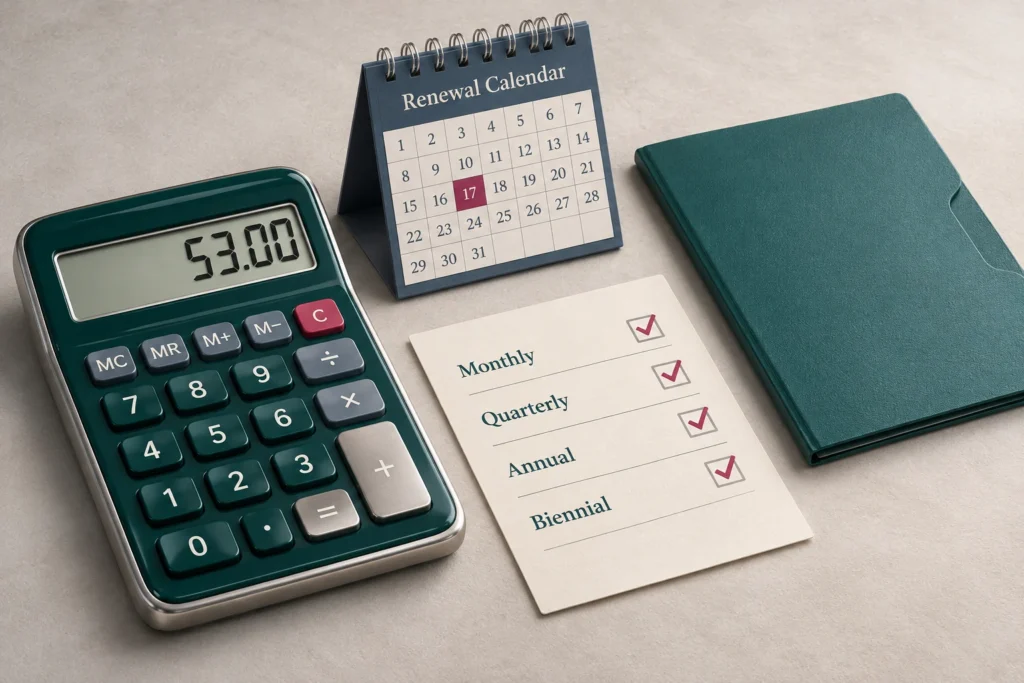
Use this free ADHD tax calculator to total unused subscriptions, avoidable late fees and impulse spending. It converts different billing cycles to a monthly amount, shows 12-month and five-year cash costs, and keeps past one-time losses separate. Download an audit CSV or a personal report, then verify each cancellation on your next statement.
Find the recurring costs you can change
Enter only costs you have identified as avoidable. Use one currency throughout. No account connection is needed. Amounts are processed in this page; they are not saved by this calculator.
Five-year figures assume the same monthly costs continue for 60 months. Growth is hypothetical, with end-of-month deposits, no taxes, fees or inflation. It is not a predicted return. Past one-time costs are not repeated or compounded.
How to use the subscription audit calculator
Start with one bank or card statement, not a complete financial overhaul. List only recurring costs you would genuinely choose to stop. Enter one line per subscription in the format name | amount | cycle. Supported cycles are monthly, annual, quarterly and weekly. Use 18.99 rather than a currency symbol or thousands separator, and keep one currency throughout.
Add your average avoidable late fees and impulse spending separately. For irregular fees, total a representative period and divide by its number of months. A past replacement purchase or missed refund belongs in past one-time costs. That field records history without pretending the loss will happen every month.
What does ADHD tax mean here?
“ADHD tax” is an informal phrase for extra costs people associate with forgetting, delayed administration or impulsive decisions. It is not a government tax, a diagnosis or a standard measure of ADHD. Anyone can use this spending worksheet. The calculator does not determine why a cost happened or claim that a planner will prevent it.
How the calculation works
| Cost type | Monthly equivalent | Example |
|---|---|---|
| Monthly bill | Amount per bill | $18 becomes $18/month |
| Annual bill | Amount / 12 | $60 becomes $5/month |
| Quarterly bill | Amount / 3 | $45 becomes $15/month |
| Weekly bill | Amount x 52 / 12 | $6 becomes $26/month |
| Past one-time cost | Shown separately | $80 stays $80, not $80/month |
Recurring monthly total = normalized subscriptions + average monthly late fees + avoidable monthly impulse spending. Annual cash cost = monthly total x 12. Five-year cash cost = monthly total x 60. Weekly normalization uses 52 billing weeks per year; actual billing dates can produce a different cash schedule. These totals assume unchanged prices and that all entered costs continue unless you act.
A worked $53 monthly example
The example button loads an $18 monthly streaming service, a $60 annual app ($5/month), a $15 monthly membership, $10 in monthly fees and $5 in avoidable impulse spending. Together they equal $53/month, $636 over 12 months and $3,180 over five years. These are constructed examples, not a customer result or guaranteed savings.
The optional growth field starts at 0%. A nonzero effective annual rate is converted to a monthly rate: (1 + annual rate)^(1/12) – 1. The scenario assumes each month’s savings is deposited at month end for 60 months. It excludes taxes, fees and inflation. Hypothetical growth is shown separately from the cash you would contribute; it is not investment advice or a forecast.
Download the audit and finish the job
The CSV template includes renewal dates, decisions, cancellation deadlines, confirmation references and a final-charge check. Its example rows are labeled and should be removed before using it. The HTML report contains your entered amounts, calculation assumptions and an action checklist, with a linked WebToolBase.com footer. Keep the report private if you add personal service names; the calculator does not save entries for your next visit.
Follow the provider’s cancellation process and keep confirmation. The CFPB explains that stopping an automatic payment does not cancel the underlying contract or debt. Check the next statement instead of counting an attempted cancellation as money already saved.
For the full workflow, read how to audit forgotten subscriptions and late fees. Use the 3-3-3 planner to reserve a small administration block, or review the WebToolBase digital planner if you prefer keeping a manual finance and renewal record. The calculator and downloads are free; no planner purchase is needed.
Frequently asked questions
Does this calculator connect to my bank?
No. You enter amounts yourself. The calculator’s arithmetic and downloads run in the page without an account connection. The surrounding website may use its normal analytics and hosting services; do not enter account numbers, card details or passwords.
Can I mix currencies or include shared subscriptions?
Use one currency per calculation. Convert amounts yourself before entering them, and include only your share of a shared subscription. The calculator does not retrieve exchange rates or split bills automatically.
Can I count an annual cancellation as an immediate refund?
No. An annual price divided by 12 is a comparison figure. A cancellation may prevent the next renewal without refunding the current period. Record any refund only after it is confirmed, and check the provider’s terms.
Why is my past one-time loss excluded from the five-year total?
A past loss is already incurred and may not recur. Repeating it for 60 months would overstate the scenario. The report keeps it separate so you can see history alongside the recurring costs you are considering changing.
Reviewed November 23, 2026. This is an educational arithmetic tool. It does not diagnose ADHD, cancel subscriptions, recover charges or guarantee a financial outcome.